
What is reverberation time?
Reverberation time is the single most useful number for describing how a room behaves acoustically — and the one most often misread.
The definition
Reverberation time is the time taken for sound in a room to decay by 60 decibels after the source stops. It is usually written as RT60 and measured in seconds, per frequency band.
What it depends on?
Two things: the volume of the room and the amount of sound absorption inside it. A large hard-surfaced hall has a long reverberation time. A similarly sized room with carpet, soft furnishings and an absorptive ceiling has a much shorter one. This is why volume alone tells you very little.
Why it matters for speech?
When reverberation is long, each syllable is still audible while the next one arrives. Consonants smear into one another and intelligibility falls. In a classroom or a language school this is not a comfort issue — it directly affects whether learners can distinguish what is being said.
How it is measured?
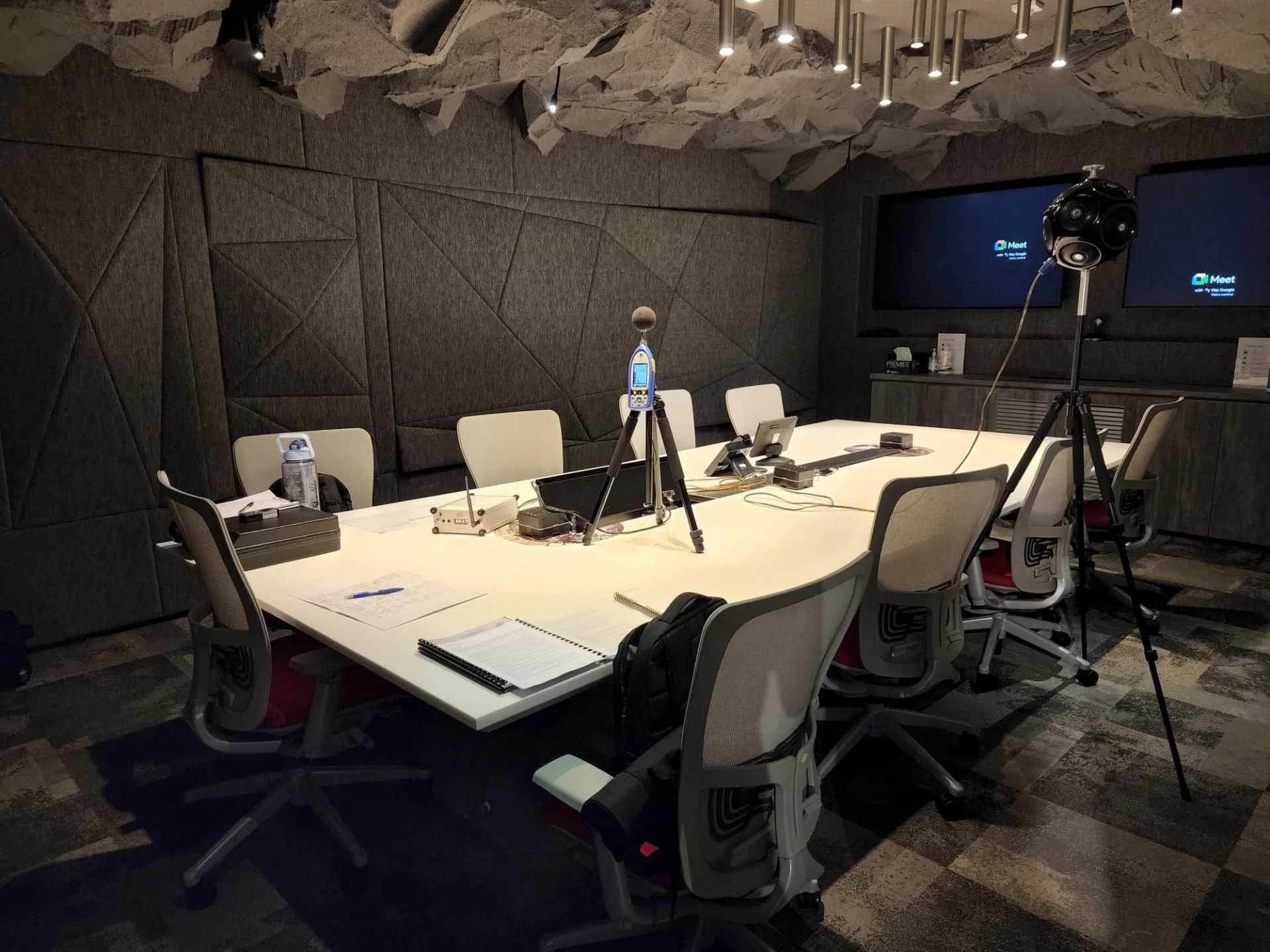
For ordinary rooms the reference method is ISO 3382-2. A source excites the room, the decay is recorded at several microphone positions, and results are reported per octave or third-octave band. The room needs to be quiet and in its normal furnished state, because furnishings absorb sound.
What to do with a bad result?
A long reverberation time is corrected by adding absorption in the right quantity, at the right frequencies, in the right locations. Guessing at panel quantities is the common failure: too little makes no perceptible difference, too much can make a room sound dead and uncomfortable. Calculating the required absorption from the measured decay is what makes the treatment proportionate.
The reverse case
A very short reverberation time is not automatically good. In a quiet open-plan office it can leave speech unusually distinct at distance, which reduces privacy. That is a different problem, and adding more absorption will not solve it.
