
Building Acoustics & Sound Privacy
How sound moves between spaces, and what to change when it moves too easily. Applicable to offices, meeting rooms, educational spaces and hospitality environments.
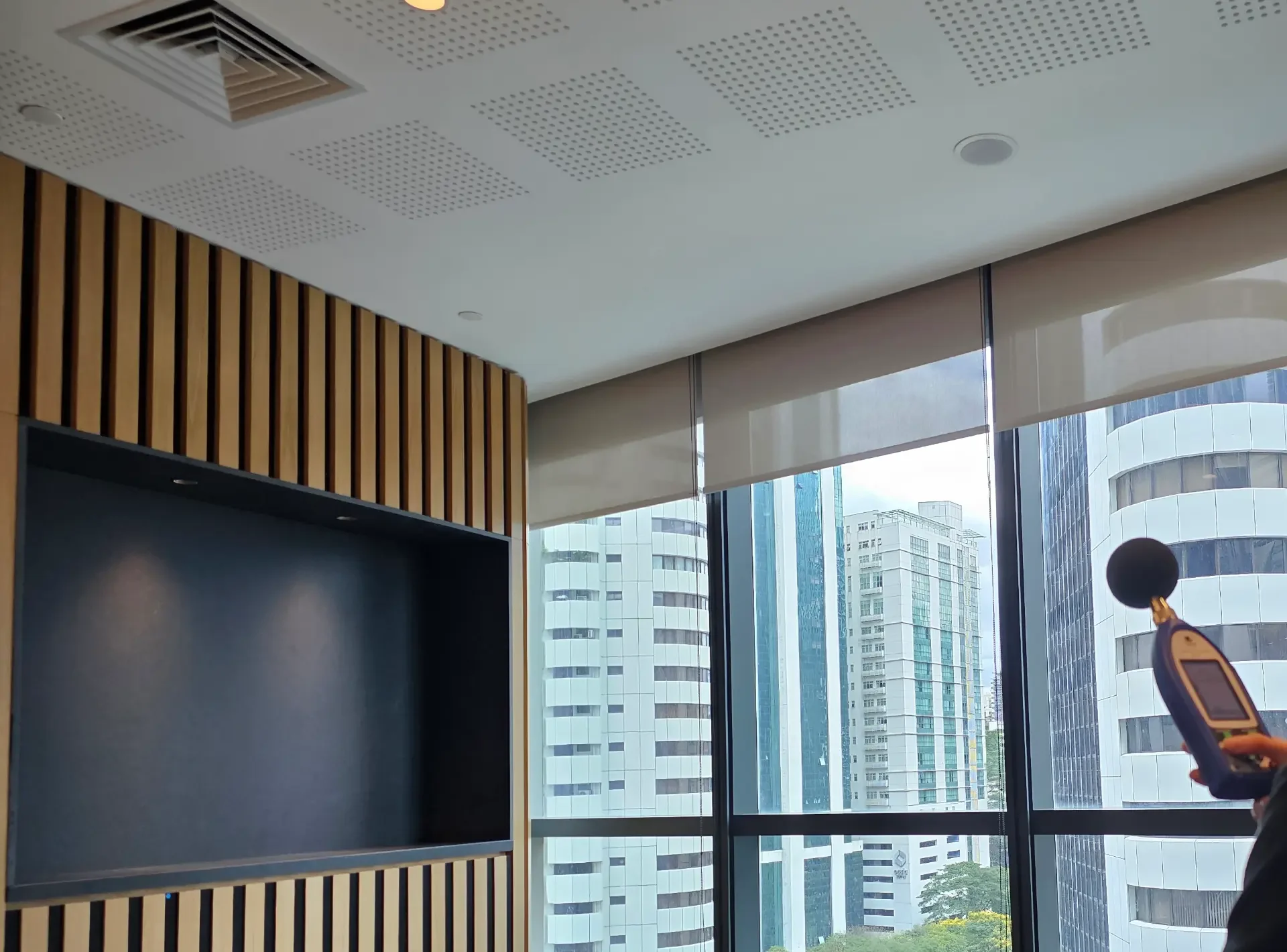
Novico project photography: omnidirectional source positioned for a field insulation test.
Four mechanisms, and the discipline to tell them apart.
-
Partition performance
The build-up itself: mass, layers, cavity, isolation and how well the specified detail was actually constructed.
-
Flanking transmission
Sound bypassing the partition through ceiling voids, raised floors, façade mullions, ductwork or service penetrations.
-
Room finishes
Hard, reflective surfaces extend reverberation, raise perceived loudness and reduce speech clarity within the room.
-
Background level
A very quiet room offers no cover. Speech from an adjacent space stands out clearly even through a reasonable partition.
Assess before you specify
We start with the spaces as built and as used. Measurement establishes the current condition; inspection of ceiling voids, service routes and junctions establishes where the sound is getting through.
Only then do we specify: partition upgrades, sealing and penetration detailing, treatment to control reverberation, or the addition of an engineered background level where the room is simply too quiet for privacy.
Design-stage review of partition build-ups and detailing
Site inspection of flanking paths and penetrations
Speech privacy assessment between specific space pairs
Remedial specification and implementation support
Post-works verification measurement
Where to next?
Sound carrying between spaces?
Tell us what you are trying to achieve. We will tell you whether it is something we can measure, model or engineer — and how we would approach it.