
Digital Engineering
Physical. Digital. Engineered. When a part exists but its drawing does not, we capture it, reconstruct it as CAD, and make it something you can manufacture, modify and keep.
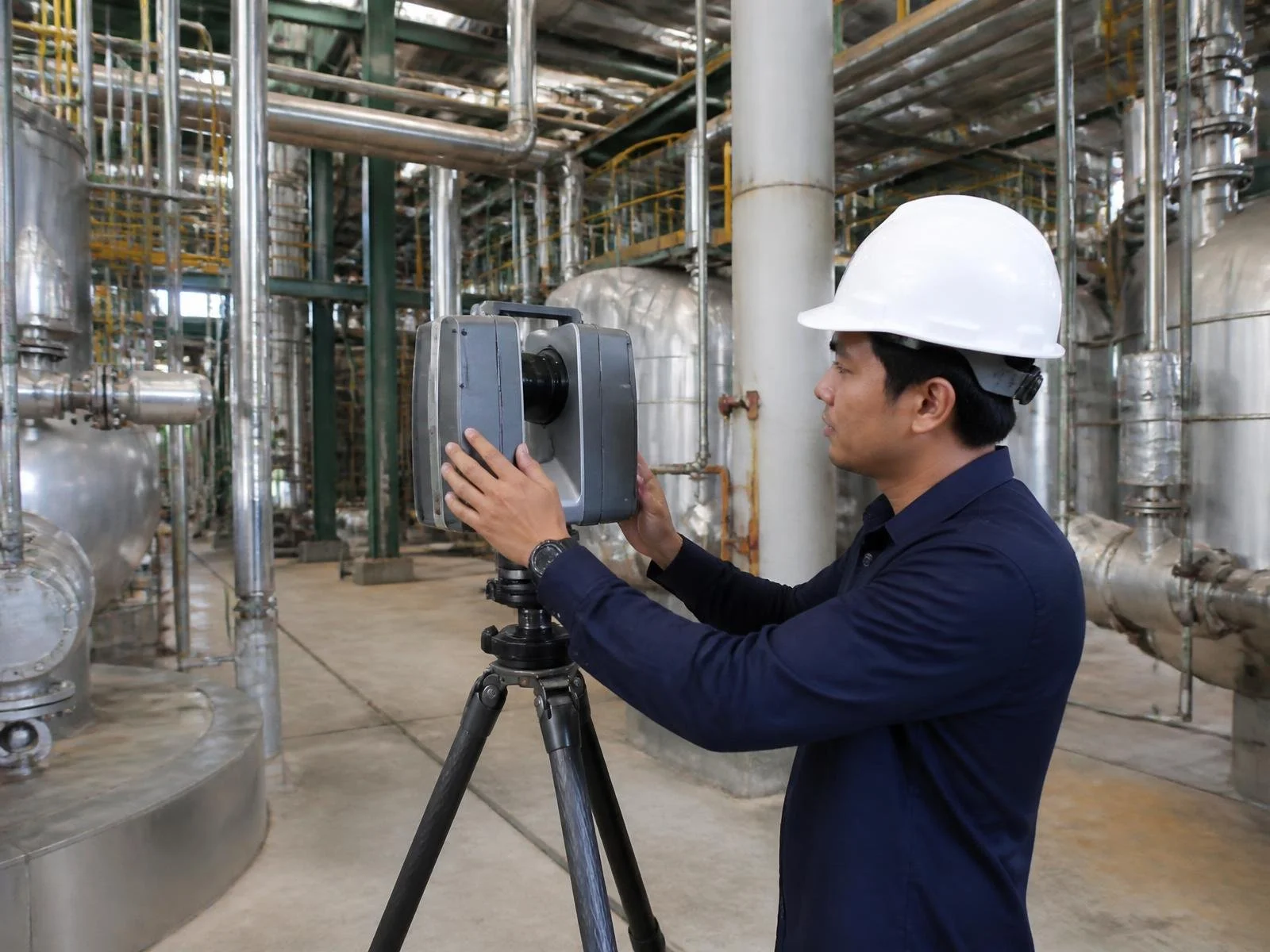
Point cloud captured from a physical component, reconstructed as surface geometry.
Our Digital Engineering Process
Capture. Reconstruct. Analyse. Improve.
-
Capture
Dimensional measurement and 3D scanning of the physical component, including features that matter functionally.
-
Reconstruct
Point cloud to mesh to parametric CAD geometry, built so that dimensions can be edited rather than merely displayed.
-
Analyse
Check the reconstruction against the part, and evaluate the design where a modification or improvement is required.
-
Improve
Modify, optimise and support prototype development, producing drawings and data for fabrication.
Physical. Digital. Engineered.
A component arrives with no drawing. It leaves as engineering data you can manufacture, modify and keep.
Stage 01 — Capture
The physical component
We start with the part itself, plus whatever context exists: function, fit, material and the reason it needs to be reproduced or changed.
Dimensional measurement and 3D scanning
Critical dimensions are measured directly. Complex or organic surfaces are captured by 3D scanning, so geometry that cannot be read with hand tools is recorded accurately.
Point cloud to mesh
The scan produces a dense point cloud, which is cleaned and processed into a surface mesh. This is a record of the part as it is — including wear and deviation.
Parametric CAD model
The mesh is reconstructed into clean parametric CAD with proper features and dimensions, so the model can be edited rather than only viewed.
Engineering modification and verification
With the design digital, it can be assessed and improved before fabrication — clearances, fixings, thicknesses, or a redesign of a feature that repeatedly fails.
For obsolete parts, undocumented assemblies and components whose original supplier or drawings are no longer available. We capture, reconstruct and deliver usable CAD.
Reverse Engineering & 3D Reconstruction
Engineering Simulation & Design
Design modification, optimisation and prototype development support in SolidWorks, using simulation to inform decisions before anything is fabricated.
What the work covers?
Reverse engineering of existing components
3D scanning and point cloud processing
CAD modelling in SolidWorks
Prototype development support
Dimensional measurement and inspection
Scan-to-CAD reconstruction
Design modification and optimisation
Engineering documentation and drawings
Digital engineering questions
-
Reverse engineering is the process of capturing an existing physical component and reconstructing it as engineering data — dimensions, geometry and a usable CAD model — when no original drawing or model exists.
-
Ideally the physical part, plus any context you have: what it does, how it fits, the material, what failed and whether it must be identical or improved. Photographs and any partial drawings help.
-
3D scanning captures the surface of a part as a dense point cloud, which is processed into a mesh. Scan-to-CAD is the engineering step that turns that mesh into a clean, parametric CAD model with proper features and dimensions.
-
Native SolidWorks files plus neutral formats such as STEP, IGES and STL, and 2D drawings in PDF or DWG where required. Tell us the downstream use and we will match the deliverable to it.
-
Yes. Once the geometry is digital, it can be modified — clearances, fixings, wall thickness, material change or a redesign of a feature that repeatedly fails.
-
Yes. We can support prototype development and 3D printed reproduction as part of the engineering process, so a design can be checked physically before committing to fabrication.
Where to next?
Have a part with no drawing?
Tell us what you are trying to achieve. We will tell you whether it is something we can measure, model or engineer — and how we would approach it.