
Acoustic treatment vs sound masking
These are not competing products. They address opposite conditions, and applying the wrong one usually makes the complaint worse.
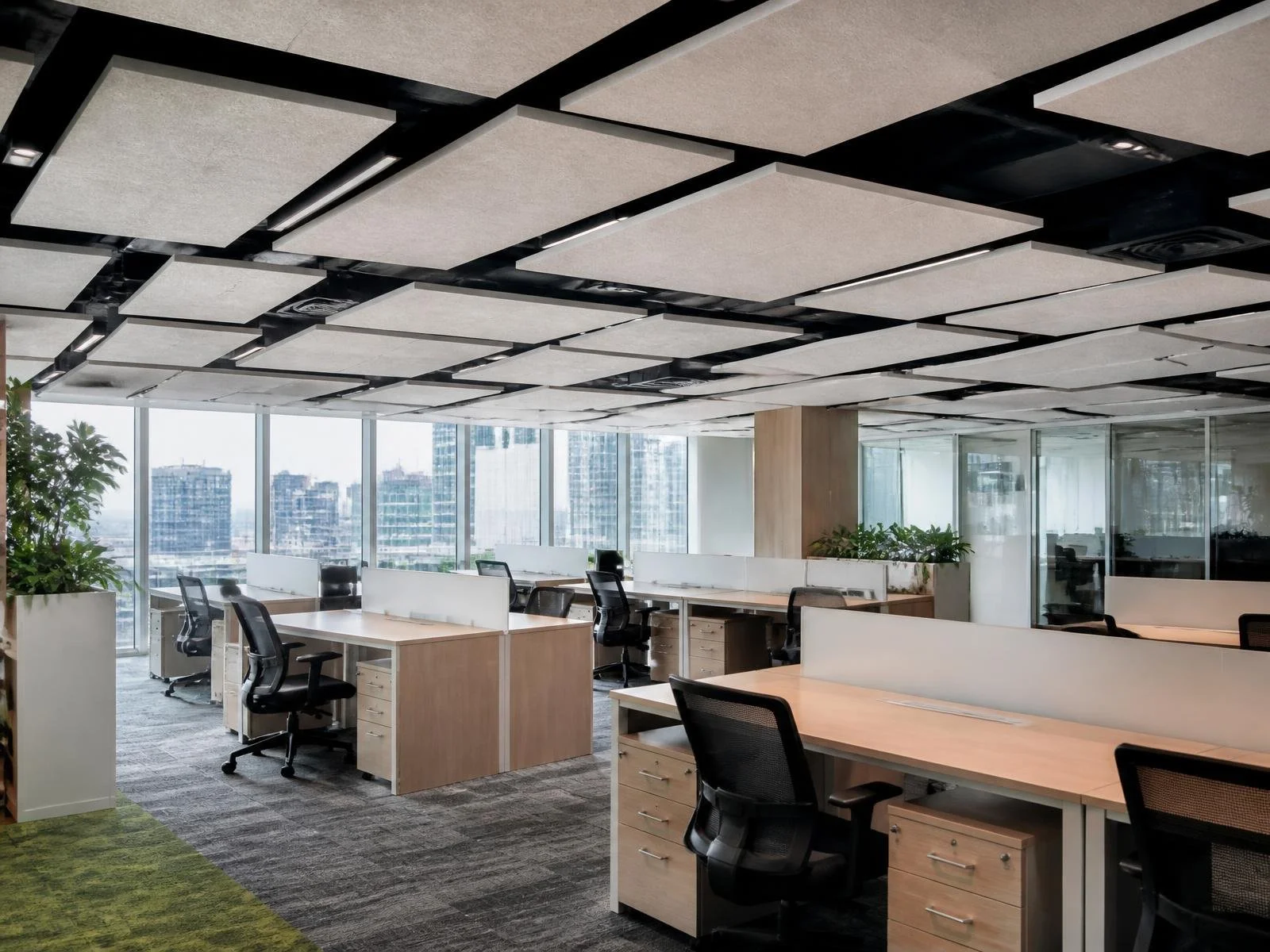
Treatment reduces reflected sound
Acoustic treatment means adding absorption — ceiling systems, wall panels, baffles — so that sound energy is removed from the room rather than reflected around it. It shortens reverberation time, reduces the general build-up of noise, and improves clarity.
Masking raises the floor
Sound masking adds a controlled background sound so that distant speech stops being intelligible. It does not reduce reflections and it does not shorten reverberation. It changes the ratio between speech and background.
Matching the symptom
"The room echoes, meetings are tiring, I can't follow speech." That is a reverberation problem. Treatment.
"It's very quiet, but I can hear every word from three desks away." That is a privacy problem in an already-absorptive space. Masking.
"I can hear the meeting through the wall." Neither. That is sound insulation — a construction issue involving the partition, its junctions and any service penetrations, and no amount of panels or speakers will fix it properly.
Why the wrong choice backfires?
Adding absorption to an already-quiet open-plan office lowers the background further and can make distant speech even more distinct. Adding masking to a reverberant hall raises the overall level in a space that is already fatiguing. In both cases the occupants correctly report that things got worse.
Together, deliberately
Many open-plan projects need both: absorption to control build-up and reflections, and masking set to an appropriate level for privacy. The point is that the combination should be the outcome of measurement, not the default specification.
